Showing posts with label Genealogy. Show all posts

Monday, May 4, 2015

Pondering Pauleen's Posers - Another Perspective


My genealogy time was pretty well-booked in April with the #AtoZChallenge and a Legacy Webinar presentation, however Pauleen Cass wrote a thoughtful post for WorldWide Genealogy To Conference or not to Conference and I made a note in my bullet journal to "get back to within the next 30 days" and comment. Here is my response and hopefully it is not too late. I appropriated Jill Ball's title (and encourage you to read her thoughts as well) to extend the theme and agree with Jill that it would be a great geneameme or Saturday Night Genealogy Fun topic.

1. During a final-day Congress panel session led by GeniAus, Josh Taylor mentioned that perhaps the term “society” is out of date for younger potential genealogists. Do you agree? Are you a member of a family history/genealogy/local history society?
I pay more attention to the aims, goals and activities of a group than to what it calls itself. That is not to say that you should not pay attention to names - certainly if the initials will be confusing or embarrassing (so be sure to check the Urban Dictionary, a standard dictionary, and give some thought to history).

Whether we use the term group, society, guild, association, gaggle, or pride - my main concern is who are you, what are you doing, why are you doing it, are you innovating or reinventing a wheel, is this a vanity project or something that is well thought out and going to impress me, what services and benefits do you offer and are you good value for the money, how invested are the administrators and the volunteers in the group, are you open to discussion and group decision-making or is this more of a top down group or clique, do you offer benefits to distance members, and am I made to feel welcome or are you simply looking for a yearly subscription/renewal.

I belong to 3 groups that address my interest in specialized studies (the Guild of One-Name Studies, the Society for One-Place Studies, and the Register of One-Place Studies). I belong to 4 national or regional/local groups (Federated Genealogical Societies, New England Historic Genealogical Society, Southern California Genealogical Society, and the Family History Society of Newfoundland and Labrador). I don't live near any of these groups and only 1 has location information that addresses my research needs, but I am impressed with all 4 groups, want to support their activities (video tutorials, webinars, online research data sets, member benefits, and publications) and I appreciate their quality newsletters and journals.

I prefer a "no drama" group and I agree with Jill that there should be term limits for officer and volunteer positions because without new blood or regular changes in posts (think of it as musical chairs for these groups and their volunteers) there seems to be a lack of member involvement, a sense of entitlement or ownership by some volunteers, a narrowing of focus or an unwillingness to try something new or look to the membership for ideas. I also think members need to be encouraged to step up and be more active in a group. If members know that someone else will always do the heavy lifting, many don't volunteer. At RootsTech/FGS, Josh Taylor gave an excellent presentation at FGS Society Day on the care and feeding of volunteers (my title not his - I think his title was New Kid on the Block) and Diane Coutant gave a brilliant talk during the morning general session on how societies were like gardens (results could be for good or ill depending on the plants, the garden, the gardeners and forces outside your control). Both of these talks should be required viewing by every administrator and postholder in any genealogy group.

2. Also I wonder if the word “genealogy” continues to fully reflect how we refer to what we do. What is your preferred term when you tell people about your hobby obsession? Is it genealogy or family history?
I get the difference in terminology. Genealogy is considered the study of direct line ancestors/descendants and a bit of just the facts (or vital statistics). Family History on the other hand is taking your genealogy research as a starting point and studying culture, language, economics, statistics, local history, world history and many other subjects to tell the stories of our ancestors (often called "putting meat on the bones").

I think most people consider themselves family historians whether they use the term genealogy or family history. With everything at our disposal today (both online and offline), we have all gone beyond the vital statistics. I don't give much thought to labels - again I agree with Jill, but do recall it being a subject of great debate (much to my surprise) in one of the groups I belong to.

3. What other things do you consider when you make a choice about attending a family history conference?
For me it is a combination of program, location, and cost. I attend a conference to learn from both the presenter and the attendees. I want a thoughtful program with enough content choices, as well as enough time in the schedule so I can meet up with attendees and do a bit of research. I am not all that interested in luncheon or dinner speakers - give us time to chat among ourselves. I want a variety of sessions (beginner, intermediate and advanced) so we also have a variety of attendees - I am always learning from others, whatever their level is. In fact, some of my most interesting "takeaways" from a conference have been those conversations in the hotel lobby or over a meal.

I would really appreciate it if the American market for conferences and seminars took advantage of poster sessions, experts' tables, and unconferencing. I would like the exhibit halls at any of the large conferences to spread the big players to each of the four corners (and make it worth their while and dollars to be there) for better flow. I would also like a more active approach to booths/stands rather than just having materials at a table (I really think that we need to step up our game in this regard, many other fields are farther along than genealogy in this area). That said I realize how expensive booths are for the average exhibitor and applaud those who make the effort. It would be great if organizers gave exhibitors enough time between sessions and perhaps a half day without sessions so that attendees don't have to make the choice between attending sessions and prowling the exhibit hall (and perhaps close down the exhibit hall at certain times so exhibitors could get a break or attend sessions).

Speakers are important - please consider a healthy combination of new speakers and seasoned speakers. More workshops and interactive sessions would be a big plus. Please realize that many of us are taking our vacation, spending our hard earned money and want to learn what you say you will be teaching. I appreciate speakers who follow through and speak/teach to their clever title or short description. I also appreciate those who take the time to prepare and update their slides (there is nothing worse than seeing someone has thrown together a few slides with clip art or a screen captures that we can't read or don't know why you have included - and when you are simply reading your slides, I have to wonder why you have so little respect for your audience). Please have a syllabus or handout that adds something to your presentation and gives me direction on how to take advantage of what you just taught me.

4. Have you been to conferences locally or nationally? Were they of benefit?
I attended RootsTech/FGS 2015 and commented about it over at my other blog The Keough Corner. I enjoyed the experience although I would have enjoyed a bit more down time between sessions. I attended a seminar put on by the Oregon Genealogy Forum a few years ago and was impressed with the sessions and the speakers (my first experience hearing Elizabeth Shown Mills - a brilliant speaker and educator). They had signups for 15 minutes with an expert on various topics and I did take advantage of it for some Swedish research. For in-depth learning, the Salt Lake Institute of Genealogy is excellent - a week's worth of focused learning and the Family History Library is quite the value for your money. Again a bit more down time for conversations among attendees would be nice.

I have attended the Lower Columbia Genealogical Society's monthly meetings when visiting my sister and that group puts on excellent presentations and their members are friendly and welcoming. I did attend a one-day seminar (location will not be named) - the group was great and their members were very friendly. Their nationally known guest speaker (at a not insignificant cost) was a huge disappointment. This speaker is an expert in his field and no doubt very accomplished. He was also completely dismissive of the attendees' questions, his presentation slides had not been updated in over 10 years, and he ignored the attendees over the lunch break - one of those moments when you realize that a big name get is not necessarily a good thing. Fairfax Genealogical Society and  the Minnesota Genealogical Society always do a great job with their seminars and conferences (in fact MNGS does pretty much everything really well).

Well, those are my thoughts on Pauleen's Posers - what are yours?
Share/Bookmark

Sunday, May 3, 2015

Reflections on April's #AtoZChallenge

introducing some of the people who are part of my family tree
What can I say - I'm happy I took on the #AtoZChallenge, I'm happy it is May (so I am finished), and I feel a little bit like that sunflower - exhausted but pleased that my efforts paid off with a bit of color and bringing new life to my blog.

  • What Was Good
    • knowing that I was part of a team and that others were working away with great ideas and interesting posts to share; 
    • having a project that I was engaged in every day (except that Sunday day of rest thing); 
    • reading blogs that blew me away with their creativity and unexpected depth;
    • picking a theme that was easy enough to write about each day and that taught me something every single time I blogged;
    • learning more about a number of family members in my Legacy family tree; and
    • hearing from other bloggers with comments (love comments) and from the co-hosts with encouragement (definitely made me want to continue and finish strong).
  • What Was Bad
    • falling behind a few times and playing catch-up (never fun); 
    • not spending enough time before April preparing for the blogging challenge; and
    • being crazy enough to want to treat my 2 blogs fairly meant I wrote 2 posts each day - some days it was 2 much!
  • What I Will Do Differently Next Year
    • Yes, I am already thinking about next year and I will start planning in about 6 months;
    • Once I have my theme (and I think themes are a huge help) I will start scouting images and word clouds as I am visual and thought it added something to my posts;
    • Write up my posts in advance - I need to get even farther in front of the project (3 to 4 days would be ideal);
    • Check in more often with other bloggers - I read 3 blogs each day just by clicking on random numbers in the #AtoZChallenge list. I definitely want more time for this aspect of the Challenge as there were so many great bloggers taking part; and
    • Encourage more of my friends and fellow bloggers to join in the fun - there is strength in numbers!
Did you follow along during the month by reading and/or posting? Did you find some new blogs to follow? Are you going to be a repeat next April? 
  • Thanks to the co-hosts for tips and suggestions, as well as your written encouragement.
  • Thanks to Jeremy Hawkins for the great artwork/graphics - normally I am not a yellow person, but I went with the bold yellows and blues and it worked. 
  • Thanks to any readers out there who gave a +1 to my posts, shared them on Facebook, or made a comment - you don't realize how much your encouragement meant. 
  • Thanks to the other Legacy software bloggers - you kept me going and I learned so much from you. 
  • Thanks to the websites that have information about given names, most especially Behind the Name and Nordic Names.
  • And finally thanks to all those family members from Ireland, Norway, Slovenia and Sweden for such great given names - your given names made the #AtoZChallenge fun, educational and entertaining - knowledge, it's a good thing.


Share/Bookmark

Thursday, April 30, 2015

Z is for Zakarias

thanks for reading this month
today is the end of April and so we reach the letter Z
It has been a crazy busy week and I am a bit behind (will get those last two up soon) but today is the last day of April and the last day of the #AtoZChallenge. Today is all about Z which is for Zakarias. We have 2 males in our family tree named Zakarias although I did notice that the spelling is shown as Zakarias, Zacharias and Sakarias, depending on the record. Since this given name belongs to my Norwegian 4th great grandfather Zakarias Pedersen, his 4 daughters and 3 sons carried on the name as their surname (got to love patronymics!) as Zakariasdattter and Zakariasen. My 3rd great grandmother gave her surname as a given name to her first son (so it made the full circle) as Zakarias.

Zakarias (or more commonly Zacharias) is the Greek form of Zechariah, meaning "Yahweh remembers." Those familiar with the New Testament will know that Zechariah was the father of John the Baptist. Variations on the name are Zacharia (Arabic), Zahari (Bulgarian), Sakari (Finnish) and Zekeriya (Turkish). To learn more about the name Zecharaih or Zakarias check out Behind the Name. And if you have not done so yet, why not check out Behind the Name for your own given name (and then add that interesting bit to your own family history). I could not find the name listed as used in either Norwegian or Swedish. In light of the Finnish spelling of the name, I am wondering if there is a Finnish connection for this family back in the 1700s. Something to add to my research to-do list.

Thanks so much for following along with me during April's #AtoZChallenge. I hope you have enjoying learning a bit about the given names in the Scandinavian and Slovenian branches of my family tree.

On behalf of my Norwegian and Swedish ancestors - Skål
and on behalf of my Slovenian ancestors - Na zdravje


Share/Bookmark

Wednesday, April 29, 2015

Y is for Ylva


Today is all about the letter Y and unfortunately we don't have any given names in our family file that begin with the letter Y. However if anyone in my family has a girl in the future I am going to suggest Ylva. Why?

  • Ylva means "she-wolf" (from the Old Norse Ulfr) which is a very strong-sounding name - I wouldn't mess with Ylva, would you?
  • I don't think little Ylva would have to share her name with too many other little girls - a unique to her name in the United States. 
Ylva is used in Sweden, Norway and Denmark. Ylva is ranked in the top 100 given names for girls in Norway (coming in at 87!). In Sweden the name day for Ylva is April 11th.To learn more about Ylva check out Behind the Name.

Are there any unusual given names in your family? Do you know what they mean?

See you back here tomorrow for our last day in the #AtoZChallenge and the letter Z!
Share/Bookmark

Tuesday, April 28, 2015

X is for Xavier


You had to know that with a strong Roman Catholic tradition in my family we would have one or two males with the name Xavier. I will admit that it is not used as a given or first name but it is often used in conjunction with Francis (as in Francis Xavier) a very popular given name in our family tree. Francis Xavier was a Jesuit priest (born Francisco de Jasso y Azpilicueta he took the name of the place where he was born Xavier, Kingdom of Navarre) who served as a missionary to East Asia. He was canonized in 1622 and his surname of Xavier was adopted as a given or middle name in many families. St. Francis Xavier is the patron saint of the Orient and missionaries.

Xavier is from the Basque place name Etxaberri meaning "the new house." Variations on Xavier are Xabier (Basque) Xaver (German) Saverio (Italian), Ksawery (Polish) and Javier (Spanish). The name day for Xavier in France and Spain is December 3. This information comes from Behind the Name, click on the link to learn more about Xavier.

See you back her tomorrow for the letter Y!
Share/Bookmark

Monday, April 27, 2015

W is for William

the given name William - used in several of our families
There are only a few given names that begin with W in my Legacy family file, and today I decided to go with the most used given name - William. We have 56 males named William and it cuts across the Irish, Norwegian, Slovenian, and Swedish branches of our tree. It also shows up in a number of our "married-ins" who come from Austria, Canada, England, Germany, and the Isle of Man. In our lines, it does not appear to be used until the late 1800s and early 1900s.

William comes from the Germanic Willahlem and is made up of the elements wil (will or desire) and helm (helmet, protection). There are several saints, kings, heroes, and writers throughout history named William. To learn more about the given name William and famous men named William (there's William the Conqueror, William Shakespeare, William Butler Yeats and William Wallace - just to name a few) check out Behind the Name. William ranks in the top ten as far as popularity in the following countries: USA, England, Canada, Sweden, and New Zealand. William is the most popular boys name in Australia, Denmark and Norway (although it might be more familiar to in the various countries where the name appears as Liam (Irish), Illiam (Manx), Vilhelm (Swedish and Norwegian) and Gwillym (Welsh).

See you back here tomorrow for the letter X - hmm?!  


Share/Bookmark

Saturday, April 25, 2015

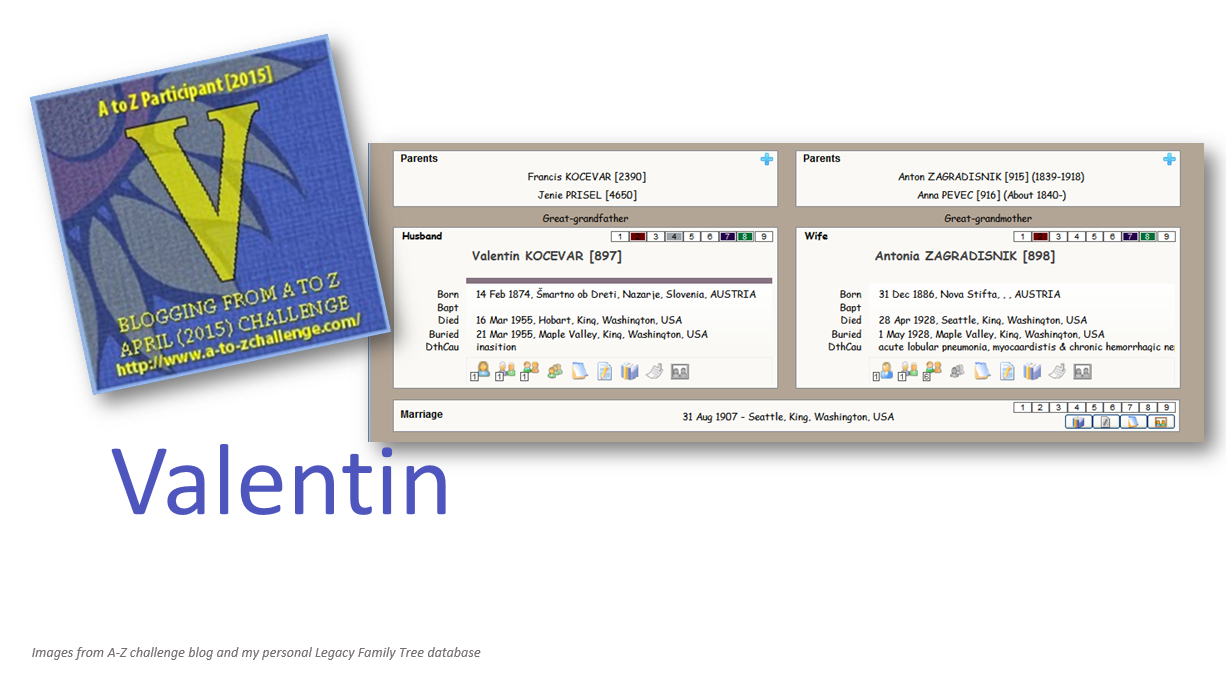
V is for Valentin

the saint's name was often used
when a baby was born on the name day  

While there are not many given names in my family file that begin with the letter V, there is one that is quite special - Valentin. My great grandfather was named Valentin and he passed the name on as a middle name to two of his sons. Perhaps it had something to do with the fact that he was born on February 14th. Valens (from the Latin) means "strong or vigorous." The name day for Valentin is February 14 in every country that celebrates name days. To learn more about the given name Valentin (or any other given names) check out Behind the Name.

Valentin is a form of Valentinus and is used in Sweden, Norway, Denmark, Germany, France, Russia, Slovenia, Croatia, and Romania. Valentin appears in various forms, some of the more interesting versions are  Balendin (Basque), Valentijn (Dutch), Balint (Hungarian), Walenty (Polish), and Folant (Welsh). Valentin is among the 50 most popular male given names in Austria and France.

Do you have anyone named for St. Valentine in your family file? 

See you back here on Monday for the letter W.


Share/Bookmark

Friday, April 24, 2015

U is for Unnamed


The theme for my AtoZChallenge here at Scandia Musings has been given names. And I have focused on the Scandinavian and Slovenian given names in my Legacy family file. But today's post is a bit different - today's post is for the 27 unnamed boys and girls who were either stillborn or died soon after their birth and were not named by their families. Their names on birth certificates appear as baby boy or baby girl or unnamed infant. I find this terribly sad and can't imagine how traumatic the death of an infant would be for these families. My heart especially went out to the Larson family who experienced this loss 3 times in 8 years. Today's post is to remember all those unnamed babies.
Share/Bookmark

Thursday, April 23, 2015

T is for Thorvald

God of Thunder, Lightening, Storms, Strength & Fertility
a name to grow into

There are several given names in my family file that begin with a T - there is Teresa/Theresa and its variations (awfully partial to that one!), Theodore, Theophilus, Thomas, Timothy, Tobias and Tracy. However the only Scandinavian given name that starts with a T in my family file is Thorvald - oh yes!

We have one family member whose name derives from Thor, the god of thunder, and how fitting is it since today is Thursday (named after, say it with me - Thor!). Yes indeed Thorvald (and its variant Torvald) is found in Sweden, Norway and Denmark because Scandinavians are found of giving their children strong names! Thorvald is made up of the elements Thor (the Norse god) + valdr (ruler) so the name actually means Thor's ruler (that seems a bit gutsy) this information comes from Behind the Name. Thorvald's name day is June 17th. Thorvald remains a popular name in Denmark, Norway and Sweden today (see a listing of famous men named Thorvald).

Do you have anyone in your family file with the name of a Norse god? Do you have any names that, while popular in Scandinavian countries, might be considered unusual in the United States? I wonder how Thorvald's name went over in North Dakota in the early 1900s.


See you back here tomorrow for the letter U.
Share/Bookmark

Wednesday, April 22, 2015

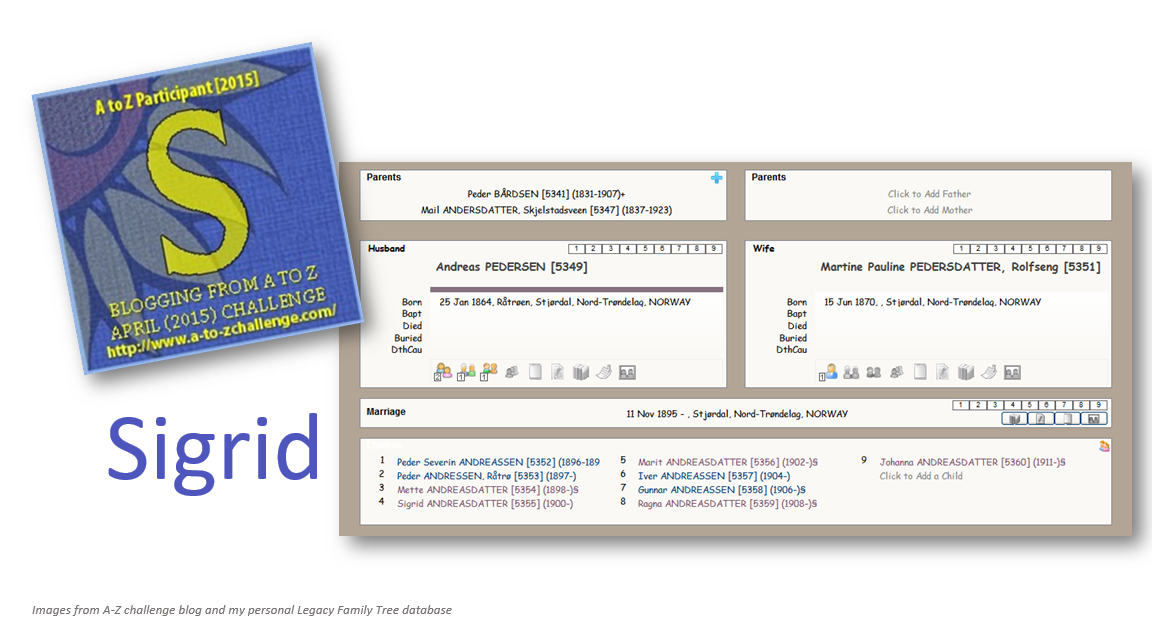
S is for Sigrid

another family that needs a bit more work 

There are lots of given names that begin with S in my family file. We have individuals named Samuel, Sarah, Simon, Stephen/Steven and Susan/Susanna. Since I am focusing on Scandinavian names in this A-Z Challenge, I selected one of the more unusual names - so today it is all about Sigrid. We have 5 women named Sigrid in my family, all Norwegian.

Sigrid comes from the Old Norse name Sigior. This is a compound name and the elements are sigr (victory) + frior (beautiful, fair). Variations on Sigrid appear as Siri and Sigfrid in Sweden, Norway, Denmark and Finland. Sigrid is ranked in the top 50 names in both Norway and Sweden, however it is rarely used in the United States (no surprise there!). To learn more about the name Sigrid check out Behind the Name (and be sure to check those links to the right-hand side of the page for additional information). September 15th is the name day for Sigrid in Sweden.

The most famous Scandinavian Sigrid (and my personal favorite) is Sigrid Undset (born in Denmark but raised in Norway), who won the Nobel Prize for Literature in 1928. Her best known work was Kristin Lavransdatter, a trilogy about life in Scandinavia (from a female point of view) in the Middle Ages. Sigrid had a fascinating life - including her family's early migration, her early failed attempts at publication, her world travels and marriage, her successful career as a novelist, her conversion from Lutheranism to Catholicism (a scandal at the time!), her flight from Norway during WWII (for opposing Hitler and speaking up for the plight of Jews), and her subsequent return to Norway after the war. Sigrid Undset is depicted on a Norwegian 500 kroner note and a two-kroner postage stamp from 1982. Sweden put her on a stamp in 1998 (this information comes from Wikipedia article on Sigrid Undset). A list of her published works is included in the Wikipedia article. If you want to learn more about her published works, check out her entry on Worldcat (a great way to find out more about authors!). I am a huge fan of historical fiction that is clever, well-researched, detailed, accurate and well-written.

Sigrid Undset ranks right up there with my favorite historical fiction author, Dorothy Dunnett. These women had an phenomenal ability to transport and immerse their readers into fascinating times in history to experience the life and culture of a distant past. If you have Scandinavian ancestors, be sure to check out the translated works of Sigrid Undset.

See you back here tomorrow for the letter T!
Share/Bookmark

Tuesday, April 21, 2015

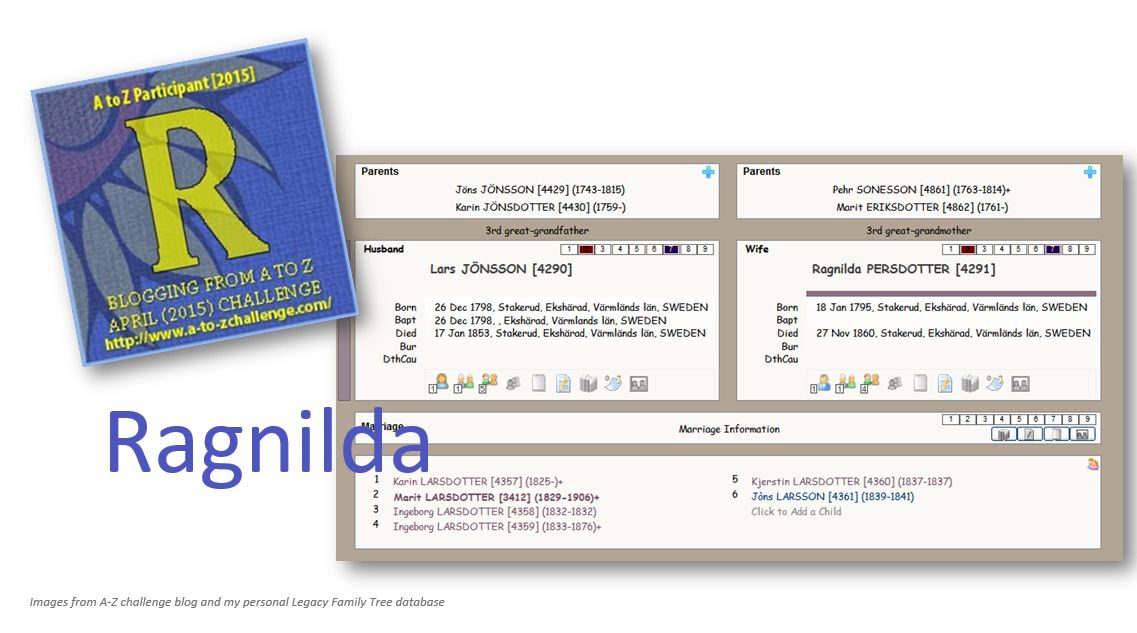
R is for Ragnilda


Today we are back to Old Norse names. My family file has 7 instances (all from Sweden) of variations of the theme of Ragnilda: 2 females are named Ragna (the diminutive and more common form used today); 2 are named Ragnhild; 2 are named Ragnilla; and 1 is named Ragnilda.

All people have certain naming traditions and reasons for them. The idea behind the Scandinavian tradition of "calling up" an ancestor by giving the ancestor's name to a child was to honor the ancestor, imbue the child with that person's virtues, and provide for the rebirth of that ancestor's spirit (the belief that something of that person would live on in the child so named). A knowledge of Norse mythology is useful in "decoding" Scandinavian names. These names are based on single or compound elements and based on qualities or the good fortune of the gods that the parents wanted the child to have. An excellent discussion of Old Norse names and naming patters is found at The Viking Answer Lady (I have only mentioned a few points here. This is a great site if you have Scandinavian heritage and want to learn more about it.)

life is a never-ending circle
"calling up" our ancestors - a Scandinavian tradition
Ragnilda means "all knowing power" and the Old Norse form of the name is Ragnhildr which is made up of compound elements (2 elements) Ragn (council/advice) + hild (fight/battle).  To see the meaning of Viking given names and their use in Scandinavia today check out Viking Given Names.  Ragnilda and its variations is found in a limited number of countries, including Denmark, Norway and Sweden (Ragnhild), Iceland (Ragnhildur), Ireland (Raghnailt), and Scotland (Raghnaid). In the Gaelic speaking countries, Raghnailt is mostly found between the 12th and 16th centuries.

Do you have any Old Norse names in your family file? Why not see what qualities or ancestors their parents wanted to "call up."

See you back here tomorrow for the letter S. 
Share/Bookmark

Monday, April 20, 2015

Q is for Quinn


There are very few given names that begin with the letter Q. Most are Arabic, Asian and African American and Native American given names and those groups are not in my family file. The one given name we have in our family tree is Quinn (it does not come from my Scandinavian ancestors though and our Quinn is one of our younger family members!). Quinn is a given name for both males and females and comes from an Irish surname "O Cuinn" meaning descendant of Conn (and Conn means "chief" in Irish Gaelic) - this information is from Behind the Name. (Notice the crown word cloud to go with this example.) It is a popular name in Canada and the United States for girls and a popular name for boys in England, Wales, the Netherlands and New Zealand. In Irish (Conn), English (Quin) and most recently in Irish and English (Quinn). 

Do you have any given names in your family files that begin with the letter Q? - that is definitely an unusual one!

See you back here tomorrow for the letter R (many more names to choose from).

Share/Bookmark

Saturday, April 18, 2015

P is for Peder

Peder and  Mali named their 4th child Peter (he died in childhood)
and their 6th child Petter (born after his brother died)
thus continuing the name Peder found on both sides of the family

Today's given name is both a popular one and an easy way to figure out. Peder is the Scandinavian form of Peter and is widely used in Sweden, Norway and Denmark. In Norway Peder ranks among the top 100 male names. Variations on the given name Peder include Petter, Per, Peer, and Pehr; and, for females, Petra. In my family file we have 15 males named Peder (all Norwegian), 18 name Per (all Swedish), 6 named Pehr (all Swedish), 4 named Petter (all Norwegian), and 22 named Peter (my Swedish, Norwegian, Irish and Italians all used the spelling of Peter with their children born in the 1900s).

Peter is derived from the Greek Petros meaning stone or rock. Probably the most famous Peter is Simon Peter, one of Jesus' apostles and the first bishop of Rome (Pope of the Roman Catholic Church). The New Testament text for this is "I say to you that you are Peter, and upon this rock I will build My church; ...." Matthew 16:18, emphasis added. The name day (feast day) for Peter in most countries is June 29th. (If you want to find your name day check out Happy Name Day).

The given name Peter is used in most countries and shows up as Botros (Arabic), Petri (Finnish), Petera (Maori), Pyotr (Russian) and Pedr (Welsh) as well as most languages/countries in between. To learn more about the given name Peder and all its variations - check out Behind the Name.

See you back here on Monday for the letter Q (that one might require some work!)
Share/Bookmark

Friday, April 17, 2015

O is for Olaf


Olaf comes from the Old Norse name Aleifr meaning "ancestor's descendent" and is a popular name in both Norway and Sweden. It is the name of kings (5 kings of Norway) and saints (Saints Olaf I and II). Unlike many other given names, Olaf is found mainly in Scandinavian countries. Variants for Olaf include Olav, Oluf, Ola, and Ole. Interestingly, where Olaf (in variant form) appears in Ireland and Scotland, it takes it spelling from the Old Norse - Amhlaoibh (Irish) and Amhlaidh or Aulay (Scottish). To learn more about the name Olaf check out Behind the Name. My family file has 2 males named Olaf (both Swedish), 6 named Ola (Norwegian), and 7 named Ole  (6 Norwegian and 1 American).

To learn more about Olaf II (Olafr Haraldsson, known as Olfa the Stout during his kingship  (1016-1030) and Olaf the Holy after he was canonized) check out the Wikipedia article. St. Olaf College, located in Minnesota, was founded in 1874 by a group of Norwegian-American immigrant pastors and farmers and named for Olaf II. St. Olaf College has an excellent Scandinavian program and maintains impressive special collections of Norwegian historical materials gathered from Norway and the United States.

See you back here tomorrow for the letter P.
Share/Bookmark

Thursday, April 16, 2015

N is for Nils

Patronymic naming patterns
Scandinavians make the search easier!

Although we only have 8 Nils in my family file, Nils is a very popular given name in both Norway and Sweden. Nils is the Swedish and Norwegian form of Nicholas. Swedish variations are Claes, Klas and Nels. Nicholas or one of its variations is found in most countries - from Nikola (Basque) to Niklas (Finnish) to Niccolo (Italian) to Nikolaj (Slovene) to Mykola (Ukrainian) and many languages in between. Nicholas comes from the Greek and means "victory of the people" (Behind the Name). Saint Nicholas is the patron saint of children, sailors and merchants as well as the countries of Greece and Russia, and he served as the basis for Santa Claus (Saint Nicholas).

As you can see with the Scandinavian patronymic naming patterns, I am able to place my "Nils" between the grandfather and the grandson. It's time to get back to my Swedish research to bring Lars Nilsson's family forward and see if he had any sons to name Nils.

from Lars to Nils to Lars
See you back here tomorrow for the letter O!


Share/Bookmark

Wednesday, April 15, 2015

M is for Marit

the pearls in my family file

Sliding in late (hey, it's tax day in the USA!) we focus on the given name of Marit. Found in both Sweden and Norway, Marit is one of the most popular girl's names. Marit is the Swedish and Norwegian form of Margaret (which shows up quite a bit on the Irish side of my family tree). Scandinavian variants of Marit are Margareta, Margit, Merit, Margrethe and Marita. Margaret and any number of variations are found in most languages and countries - from Margarida (Catalan) to Maret (Estonian) to Mairead (Irish) to Margareta (Romanian to Mereid (Welsh) and every language in between. To see all the variations, visit Behind the Name.

Margaret is derived from Latin and the name means "pearl." In my family file we have 51 females named Marit - 34 from Sweden and 17 from Norway. One of my favorite "pearls" is my second great grandmother Marit Larsdotter who, with her husband Elof Larsson (no relation!) and their grown children, left Sweden in 1882 at the age of 52 and came to the United States. Leaving the only place they had ever known, at that age, to make a new life for themselves in Minnesota must have been quite daunting. Whenever I take on an especially difficult or intimidating task, I think of Marit and her courageous journey.  
One of my favorite families!
Who are the "pearls" in your family tree? Why not tell their stories.

See you back here next time for the letter N.


Share/Bookmark

Tuesday, April 14, 2015

L is for Lars

3 sons named Lars
I need to get back to my research on this family!

The proverbs "If at first you don't succeed, Try, try, try again" or "Third time's the charm" seem to fit this family. Three sons were born and named Lars before one survived. It is quite common in my Irish and Scandinavian families to reuse a given name if a child dies (as it usually was that of a grandparent). Sadly the father, Erik Hansen, died when Lars was just 15 years old. It appears I had only partially researched this family (thankfully I made copies of the bygdebok pages while in Salt Lake City). When I noticed I only had the bare bones of my research entered into Legacy, I went back to find the bygdebok pages. Happily I found Lars Eriksen Skjelstadsveen at Hammertrøen (page 489). Lars married twice and had seven children. His daughter Mali and her husband Anders took over the farm (and had two children). Now to go back and find the corresponding birth/baptism, marriage, death/burial and census records to piece together what happened to Lars, his two wives and seven children. I definitely need to get back to my Norwegian research!

But before I do that - Lars is a Scandinavian name that means victorious. Lars is used in Denmark, Germany, Finland, the Netherlands, Sweden and Norway. It is a very popular name (Lars appears 44 times in my family file, 37 times for Sweden, 6 for Norway, and 1 for the USA, of course - Minnesota!). Lars is the Scandinavian form of Laurence which derives from the Latin laurus or "laurel." St. Laurence was a 3rd century deacon who according to legend was martyred from Rome. St. Laurence is a popular saint's name and variations of the name are used all over the world - from Croatia (Lovro) to France (Laurent) to Portugal (Lourenco) to Slovenia (Lovrenc) and many countries in between. To learn more about the names Lars and Laurence check out Behind the Name.

See you back here tomorrow for the letter M!


Share/Bookmark

Monday, April 13, 2015

K is for Karin


We have 17 females in my Legacy database with the given name of Karin and all of them are Swedish. Karin is the Swedish short form of Katherine or Kadhrin and it is commonly used in Denmark, Germany, Finland, Norway and Sweden. The Scandinavian meaning of Karin is "pure." Both Karin and Carin are used (although each of our instances is spelled with a K). August 2 is the name day for Karin in both Sweden and Norway. To learn more about the name Karin check out Nordic Names.

A variation on Katherine is found in most languages from Basque (Katalin) to Hawaiian (Kakalina) to Polish (Karina) to Welsh (Catrin). Behind the Name states that the etymology for Katherine is debated and could derive from the Greek "each of two", from the name of the goddess Hecate, or from a Coptic name meaning "my consecration of your name."

Tomorrow it will be time to return to a male name - see you back here for the letter L! 
Share/Bookmark

Saturday, April 11, 2015

J is for Johanna

a partial listing of my Johannas
Johanna appears in my family file 31 times. The name Johanna is very common and comes from the Latin Ioanna. Johanna is the feminine form of Ioannes (or John). And the spelling of John/Johanna is used in the New Testament - John was a disciple of Christ, and there are more than a few Johns who are saints (see Saint John). Johanna is among the 100 most popular girl's names in Austria, Hungary, the Netherlands and Norway.

Johanna has a tremendous number of variations - everything from the African American (Tajuana) to the Welsh (Siwan) and many others in between, including Johanne, Joan, Joanna, Hanna, Jenny, Jonna, Hanne, Jannike, Jenna, Jenni, Chevonne, Shevon, Ivana, Jovana, Ivanka, Nina, Juana, Juanita, and Giovana. For this #AtoZChallenge I have only included my numbers for Johanna, but I think I will go back and check out all the variations, perhaps in May!

To learn more about Johanna or any other given names, check out Behind the Name.

And just for the record, while working on the letter J, I discovered I have 233 males in my family tree with the given names James (something for next year!).

See you back here on Monday for the letter K!
Share/Bookmark

Friday, April 10, 2015

I is for Ingeborg

Ingeborg - from grandmother to granddaughter

This one comes as a bit of a surprise - Ingeborg appears 43 times in my family file! Now admit it - you don't hear the name Ingeborg much in the United States. However, it is a common name in Norway and Sweden. 15 of my Ingeborgs were Norwegian, 27 were Swedish, and 1 was American (of course, she was born in Minnesota).

Ingeborg is "from the Old Norse name Ingibjorg, which was derived from the name of the Germanic god ING combined with bjorg meaning "help, save, rescue." (from Behind the Name). Ingeborg is found in Denmark, Germany, Norway and Sweden. In Norway, Ingeborg is the 75th most popular girl's name! Variations on Ingeborg include Ingebjorg, Ingeburg, Inga, Inge, and Inka.

As you can see from the cover family view (above), often the mother's name was given to a daughter and/or a granddaughter, and the given name continues down through the family tree. Kerstin's mother Ingeborg is the first occurrence of the name in my family tree and Kerstin gave the name to her first daughter.

What I have noticed so far with my theme of given names for the #AtoZChallenge is that Scandinavian given names come from Norse gods and are often associated with strength, honor or battle, while Irish given names come from the Bible and reflect various Saints' names (must have been that baptism requirement!).

Where do your given names come from and do they meander through your family tree in each generation?

Hope to see you back here tomorrow for the letter J.
Share/Bookmark